S/4HANA
AI in ERP
SAP Activate
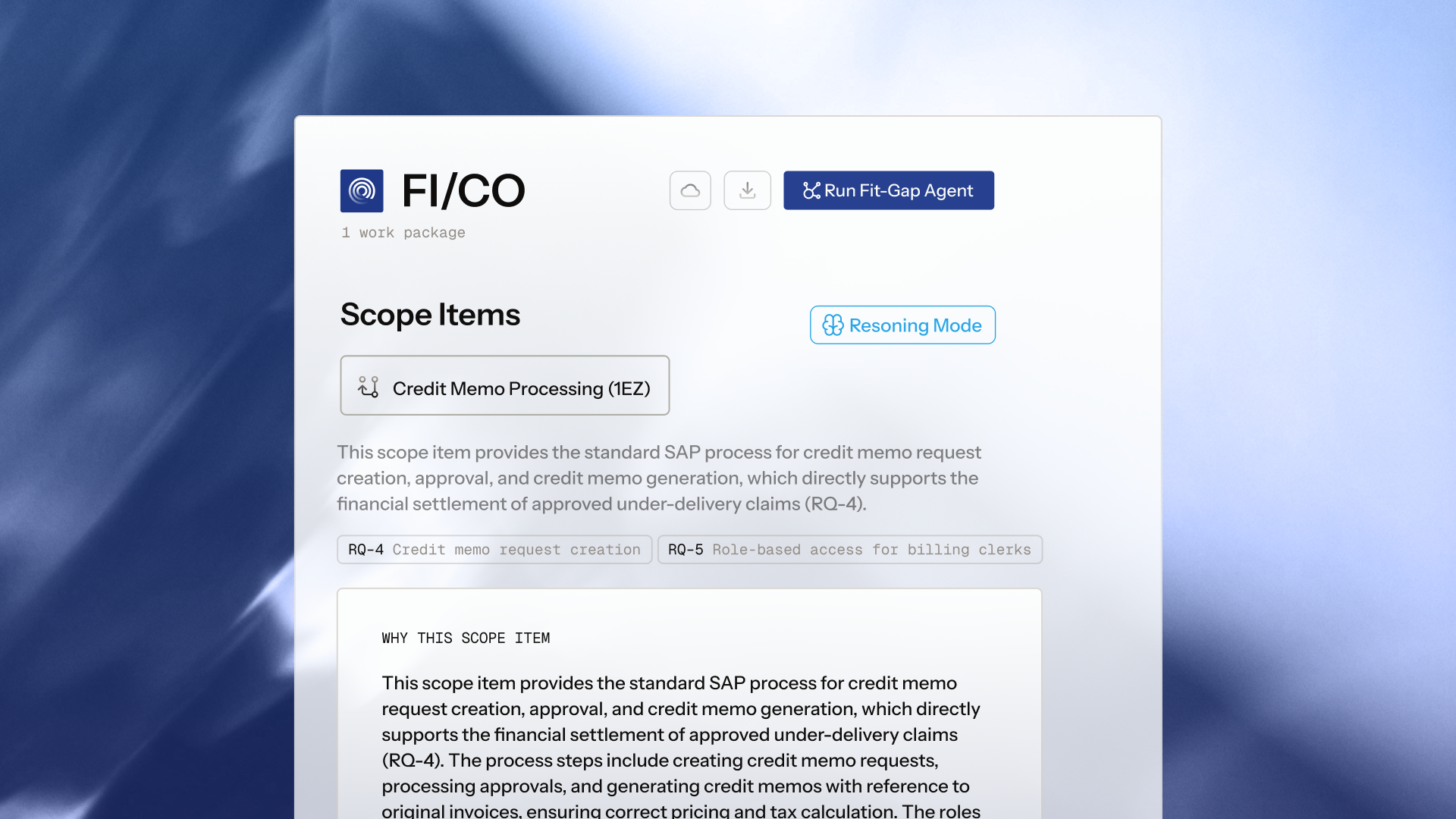
SAP Activate organizes delivery through a clear hierarchy: workstreams → deliverables → tasks → accelerators (templates, guides, links). That structure is not bureaucracy—it is a mechanism to keep alignment across a large program.
In the Explore phase, the core engine is fit-to-standard workshops: a structured way to validate how standard SAP Best Practices align with the business, while capturing configuration values, extension needs, integration points, and gaps.
The expected outputs are not vague. Explore typically produces, among others:
The problem: teams often conduct the workshops, but the outputs arrive late, inconsistent, or untraceable; consequently, Realize becomes a rediscovery phase. That's where time and budget evaporate.
Across ERP research, one recurring theme is that success depends on disciplined execution across phases, not just "having a plan." Stage-based thinking matters because what you produce early shapes outcomes later.¹²
In requirements engineering, the challenge is even more explicit: requirements are a communication and shared-understanding problem as much as a technical specification problem. Consequently, when workshops are documented poorly, misunderstandings calcify—and then reappear as change requests, test defects, and adoption issues.
Traceability research consistently links requirements traceability practices to better change impact analysis and artifact consistency—exactly what SAP programs need when scope evolves.³
If AI is going to help SAP Activate, it should reduce entropy between human conversations and structured execution. Practically, that means turning:
into
Recent literature reviews on large language models in requirements engineering show the strongest value in language-intensive activities like elicitation support, validation, classification, and downstream tasks like test generation—but also highlight the need for real-world workflow integration and evaluation beyond toy examples.
So: the winning pattern is not "ask an LLM questions." It's AI embedded in a governed pipeline, with quality gates and human accountability.
A robust approach looks like this:
1. Capture inputs in a structured way
Use transcripts (live or recorded), but also capture participants and roles, scope items / process areas covered, and decisions made versus open questions.
2. Extract requirement candidates (then normalize)
AI can propose requirement candidates, but they must be normalized into a consistent object model, e.g.: ID, title, description, process area / scope item link.
3. Validate requirements quality
A "good" requirement is testable and unambiguous. Your governance should include ambiguity checks, duplicate detection, conflicts or inconsistencies, and missing acceptance criteria.
This is where human-in-the-loop is non-negotiable: AI accelerates drafting and structuring; SMEs approve.
Fit-to-standard workshops are designed to confirm whether standard processes meet requirements, and to identify configuration values, extensions, integration points, and gaps.
Process flows are the missing link between business alignment and technical execution. Good flows:
Process modelling quality is a known challenge in practice; empirical and guideline-based research exists because teams frequently create inconsistent or low-quality BPMN models at scale.
AI can accelerate process flow creation if (and only if) it uses the validated requirement set, the fit/gap decisions, the agreed process steps and lanes, and outputs in a modeling-friendly structure (BPMN-ready, reviewable).
For SAP programs, the real win is producing flows that are immediately usable in process tooling such as SAP Signavio Process Navigator and related modeling environments—without spending weeks of manual rework.
Rather than ranking vendors, it's more useful to think in capability layers—because SAP programs rarely succeed with a single tool.
1. SAP-native baseline (non-negotiable)
2. Process intelligence + modeling
3. Requirements + testing + traceability Your program needs traceability across: requirements ↔ process flows ↔ configuration ↔ tests ↔ defects. Systematic reviews show Requirements Traceability is central but challenging.⁴ Tooling and automation help, but governance is what makes it real. LLMs can assist with trace link creation, but should incorporate validation and auditability.⁵
4. Knowledge management and "deliverable operations" This is the layer most programs underestimate: consistent templates, reusable "golden" process patterns, decision logs, and the ability to regenerate outputs when scope changes. That is exactly where "AI for SAP Activate" becomes practical rather than theoretical.
To avoid "AI theater," implement these controls:
Without these, AI increases risk instead of reducing effort.
SAP Activate already tells you what good looks like: fit-to-standard workshops that produce a backlog, design artifacts, configuration and integration decisions, and eventually process documentation that enables Realize.
Qorelo is built specifically for the hardest part of Activate: turning discovery into deliverables, fast.
What that means in practice:
The payoff is not "AI content." It is fewer workshops, faster alignment, less rework in Realize, and traceable decisions that survive steering committees and scope change.
If you are using SAP Activate (or want to use it properly), the best AI is the one that produces the same artifacts your project already needs—with enterprise-grade control, consultant-grade structure, and outputs that integrate with your SAP toolchain.
When you visit this site, it may store or read information on your device using cookies and similar technologies. Some are required to run the site; others are used only if you allow them. You can change your choice at any time from this panel.
Privacy policy Imprint Terms of service



.png)